
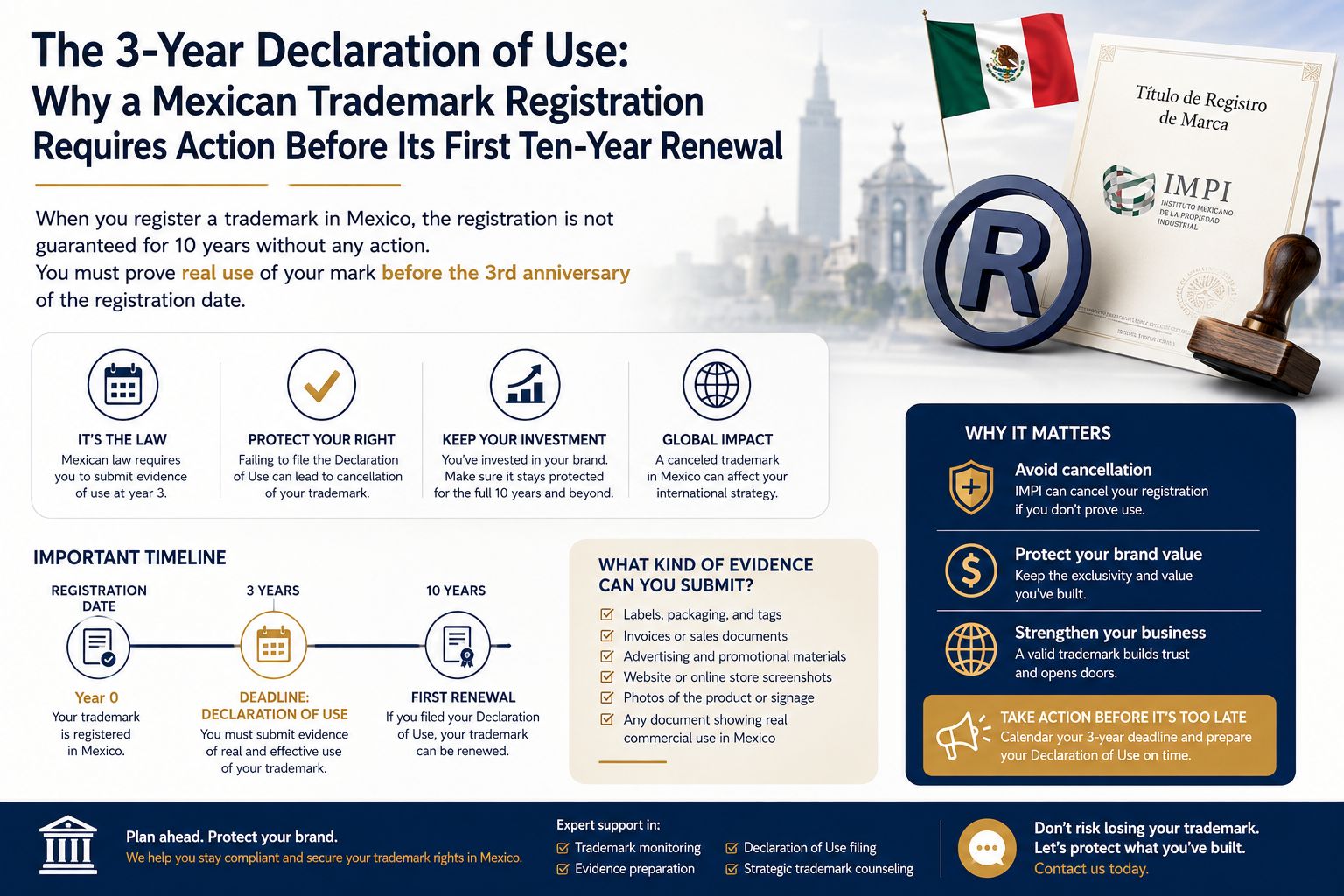
Foreign trademark owners frequently assume that obtaining a registration from the Mexican Institute of Industrial Property (IMPI) means their trademark is fully protected for ten years without further action. While Mexican trademark registrations have a ten-year term, the law imposes an important use-related requirement before the first renewal
Foreign trademark owners frequently assume that obtaining a registration from the Mexican Institute of Industrial Property (IMPI) means their trademark is fully protected for ten years without further action. While Mexican trademark registrations have a ten-year term, the law imposes an important use-related requirement before the first renewal: in applicable cases, the trademark owner must file a Declaration of Real and Effective Use following the third anniversary of the registration.
Under Article 233 of the Federal Law for the Protection of Industrial Property (LFPPI), the owner of a registered trademark must declare its real and effective use, identifying the specific goods or services to which the trademark is applied. The declaration must be filed with IMPI during the three months following the third anniversary of the registration.
This deadline is critical. If the owner fails to declare use within the statutory period, the registration lapses by operation of law. No separate administrative declaration by IMPI is required for this particular type of lapse. Article 260 of the LFPPI expressly identifies failure to file the Declaration of Use required by Article 233 as a ground for expiration of the registration, while Article 263 confirms that this specific expiration does not require an administrative declaration by the Institute.
The Declaration of Use also has an important limitation: trademark protection continues only for the specific goods or services for which use has been declared. In other words, a trademark owner should not simply treat the declaration as a procedural formality. The declaration requires a careful review of the goods and services that are actually being used in Mexico, because the scope of the registration after the declaration is tied to the goods or services identified in the filing.
This requirement differs in important respects from trademark maintenance practices in other jurisdictions. For example, the Mexican Declaration of Use is not presented as a traditional evidentiary filing requiring the routine submission of invoices, specimens, or other documentary evidence of use. Instead, the statutory filing requires the trademark owner to declare the real and effective use of the mark and identify the specific goods or services covered by that use. This does not eliminate the importance of maintaining evidence of use, however, because evidence may become relevant in other trademark proceedings or disputes.
Trademark owners should therefore distinguish between three separate concepts: the ten-year term of the registration, the three-year Declaration of Use requirement, and the Declaration of Use required in connection with renewal. These are separate statutory obligations and should not be treated as a single maintenance event.
For foreign trademark portfolios, deadline management is particularly important. A portfolio manager may have registrations in multiple jurisdictions, each with different maintenance requirements and deadlines. A Mexican registration should therefore be reviewed based on its specific grant date and the goods or services actually in use in Mexico.
Through declaraciondeuso.mx and declaraciondeuso.com, we provide specialized reviews of Mexican trademark portfolios to identify upcoming Declaration of Use requirements and verify the goods and services that should be maintained. Our objective is to help foreign trademark owners avoid missed deadlines, unnecessary filings, and preventable losses of protection.
A Mexican trademark registration may have a ten-year term—but the first three years can create an important statutory deadline. Verify your Declaration of Use before that deadline arrives.